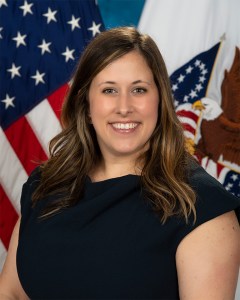
STATEMENT FOR THE RECORD BY
KAREN GUICE, MD, MPP
EXECUTIVE DIRECTOR OF THE FEDERAL RECOVERY
COORDINATION PROGRAM
BEFORE THE
SUBCOMMITTEE ON OVERSIGHT AND INVESTIGATIONS,
HOUSE COMMITTEE ON VETERANS' AFFAIRS
April 28, 2009
Good morning Chairman Mitchell, Ranking Member Roe, and Members of the Committee. My name is Karen Guice and I am the Executive Director of the Federal Recovery Coordination Program. I am delighted to have this opportunity to update you regarding the Federal Recovery Coordination Program (FRCP) and Care Coordination across VA’s health care system.
The FRCP is designed to assist recovering service members, Veterans, and their families with access to care, services, and benefits provided through the various programs in DoD, VA, other federal agencies, states, and the private sector. The program is operated as a joint program of the Departments of Defense (DoD) and Veterans Affairs (VA), with VA serving as the administrative home. Specific program eligibility criteria were approved by the VA/DoD Senior Oversight Committee in October 2007 and include those service members or Veterans who are receiving acute care at military treatment facilities; those diagnosed with specific injuries or conditions; those considered at risk for psychosocial complication; and those self-referred or Command-referred based on perceived ability to benefit from a recovery plan.
Referral
Recovering service members and Veterans are referred to the FRCP from a variety of sources, including from the service member’s command, members of the multidisciplinary treatment team, case managers, families already in the program, Veterans Service Organizations and non-governmental organizations. Generally, those individuals whose recovery is likely to require a complex array of specialists, transfers to multiple facilities, and long periods of rehabilitation are referred. When a referral is made, a Federal Recovery Coordinator (FRC) conducts an evaluation that serves as the basis for problem identification and determination of the appropriate level of service.
Federal Individual Recovery Plan
The Federal Individual Recovery Plan is designed to efficiently and effectively move a service member or Veteran through transitions by accessing the services and benefits appropriate to the identified needs and goals. The Plan is created with input from the service member or Veteran, their family or caregiver, and from members of multidisciplinary health care team. The FRC implements the plan by working with existing governmental and non-governmental personnel and resources.
Staffing
Fourteen FRCs are working at six military treatment facilities and two VA medical centers. They are supported by a VA Central Office staff that includes an Executive Director, two Deputies (one for Benefits and one for Health), an Executive Assistant, and a Staff Assistant. In addition, the program receives personnel support at VA Central Office from the U.S. Public Health Service and DoD, with each sending two individuals on detail.
Predicting the total number of FRCs required for the program at any point in time depends on the number of eligible service members and Veterans enrolling and workload criteria based on intensity of needs. The program has developed a hiring plan based on estimates of eligible populations and a variety of estimated workloads. If referral and enrollment rates are higher or lower than projected, the number of new FRCs hired can be adjusted accordingly.
Coordination
Within VA, a robust system to coordinate care for severely ill and injured service members as they transition from DoD to VA’s health care system is in place. VA has strategically placed 27 VA Liaisons for Health Care at 13 military treatment facilities with concentrations of recovering service members returning from Afghanistan and Iraq. Each VA medical center also has an OEF/OIF Care Management team to coordinate patient care activities and ensure that service members and Veterans are receiving patient-centered, integrated care and benefits. Members of the OEF/OIF Care Management Program team include: a Program Manager, Clinical Case Managers, a Veterans Benefits Administration (VBA) Veterans Service Representative, and a Transition Patient Advocate. For those with more severe conditions, such as severe polytrauma and traumatic brain injury, spinal cord injury, or severe visual impairment and blindness there are specialty care managers available. The Federal Recovery Coordinators and VA case managers work collaboratively for those service members and veterans that are cared for within VA.
Roles and Responsibilities
While the concept of care coordination is not new, what is new is its application to managing and assisting injured and ill service members and Veterans as they navigate the various transitions associated with recovery without duplicating services. FRCs do not directly deliver services; they coordinate the delivery of services and serve as a resource for service members, Veterans and their families.
Within the overall framework of care coordination and each client’s particular needs and goals, the FRCs work with military liaisons, members of the Services Wounded Warrior Programs, service recovery care coordinators, TRICARE beneficiary counseling and assistance coordinators, VA vocational and rehabilitation counselors, military and VA facility case managers, VA Liaisons, VA specialty care managers, Veterans Health Administration (VHA) and VBA OEF/OIF case managers, VBA benefits counselors, and others.
Within VA, care management begins with VA Liaisons for Health Care, who facilitate the patient’s transition from a military treatment facility to a VA health care facility that provides the most appropriate medical services required for their condition nearest to home. VA Liaisons also coordinate closely with DoD Case Managers to identify service members who are transitioning from the military as outpatients. VA Liaisons educate service members and their families about VA’s system of care, help coordinate their initial registration with VA, and secure appointments within VA health care for these service members prior to their leaving the military treatment facility. The FRCs and VA Liaisons work closely to coordinate care and referrals.
All severely injured OEF/OIF Veterans are provided with a case manager, and any other OEF/OIF Veteran screened may be assigned a case manager upon request. The Program Manager ensures that all OEF/OIF Veterans are screened for care management. Clinical Case Managers coordinate patient care activities and ensure that all clinicians providing care to the patient are doing so in a cohesive and integrated manner. VBA team members assist Veterans with the benefit application process and education about VA benefits. The Transition Patient Advocate serves as a problem solver by facilitating activities between the VA medical center, VBA, and the patient or family, serving as a facilitator and problem solver.
The OEF/OIF Care Management team collaborates with the FRC assigned to a Veteran or service member as an adjunct team member in coordinating services across the continuum of care. VA has a care management tracking database that is patient specific. This data base provides an immediate identification of the service member or Veteran’s current VA case manager. FRC’s ,VA case managers, and VA Liaisons all have access to this database.
Resources
The FRCP is supported by a variety of sources. VA supports the FRCP through office space at Central Office, technical and information technology (IT) support, access to human resources and budget specialists, and an “open door policy” for access to both VBA and VHA for programmatic support. The program also has access to the expertise and guidance from VA’s Office of Public and Intergovernmental Affairs, Office of Congressional and Legislative Affairs, and Office of General Counsel.
DoD provides assistance to the program through the Transition Policy and Care Coordination Office and the Senior Oversight Committee and staff. This support includes assistance with reporting requirements, development of appropriate tools, and coordination of activities. Military liaisons to VA from Army Wounded Warrior and the Marines serve as consultants to the program.
FRCs are individually supported by their host facilities. This support includes information technology assistance, office space and supplies, and other support as necessary.
Challenges
The FRCP has undergone two formative program evaluations to assist in its development. From the first to the second evaluation, progress was noted in the following areas:
Ongoing challenges for the program include the following:
Conclusion
The Federal Recovery Coordination Program is still new and we continue to learn ways to improve the program every day. In closing, I would like to share with you
the service pledge recently developed by the Federal Recovery Coordinators. It reads:
Connect with the Service Member or Veteran, and those who care for them;
Appreciate the Service Member or Veteran's challenges;
Respond to the needs of the Service Member or Veteran; and
Empower the Service Member, Veteran, family or designee to solve problems.
The FRCP, together with the care management system and processes within VA and DoD, are committed to ensuring that our injured Veterans and service members receive the care, services and benefits that they so richly deserve. Your support is greatly appreciated and I look forward to your questions.