


From Patient to Professional: How the Augusta Blind Rehabilitation Center Changed Ms. Scott’s Life
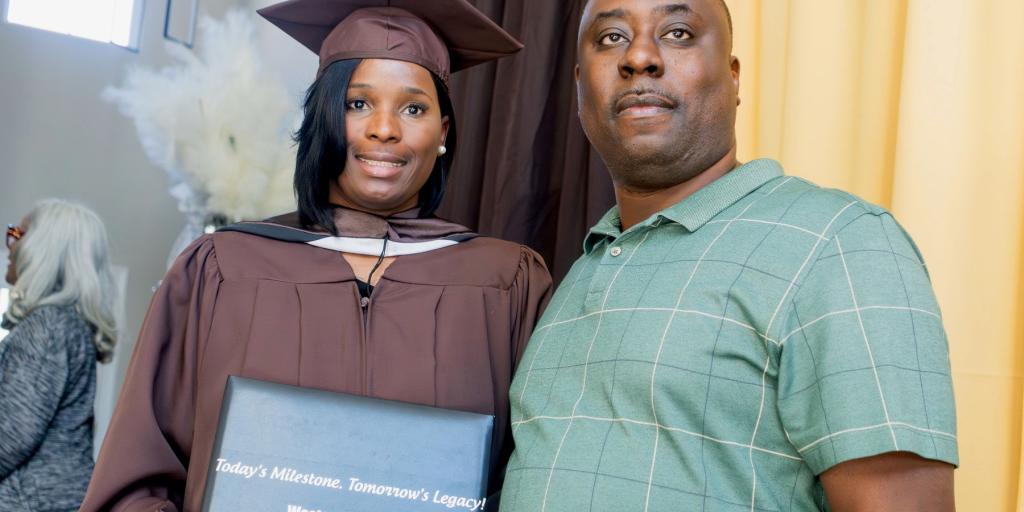
Tamika Scott walked into the Augusta Blind Rehabilitation Center believing she had lost her future. She left believing she had found her purpose.
When Mrs. Scott first began losing her vision to Stargardt’s in 2012, she never imagined how dramatically her life would change. By 2018, her vision had declined rapidly, and she found herself grieving not only the loss of her sight but also the loss of her independence and confidence. Giving up her driver’s license was one of the hardest moments of her life. Equally heartbreaking was realizing she could no longer clearly see the faces of her family and friends.
Although Mrs. Scott still had some usable vision, it wasn’t enough to live the life she once knew. She questioned her purpose and wondered what her future would look like. For a time, she believed her dreams were slipping away.
Mrs. Scott had been accepted into a master’s program to become a Teacher for the Visually Impaired. Unfortunately, she had to medically withdraw after only a few weeks because she simply could not keep up. Without adaptive technology or the skills to access her coursework efficiently, assignments that took her classmates one hour often took Mrs. Scott eight to ten hours. She was exhausted, discouraged, and uncertain whether she would ever accomplish her goals.
At the recommendation of her physicians at Johns Hopkins, Mrs. Scott enrolled in the Augusta Blind Rehabilitation Center. Looking back, she describes it as one of the greatest gifts she has ever received.
The Augusta Blind Rehabilitation Center did far more than teach Mrs. Scott adaptive techniques—it restored her confidence, renewed her independence, and gave her hope for the future.
The first lesson Mrs. Scott learned was to give herself grace. From there, she developed orientation and mobility skills that helped her travel safely and confidently. She learned adaptive cooking techniques, manual skills, and how to safely use kitchen appliances. She was introduced to magnification devices, adaptive equipment, and accessible technology that completely transformed the way she learned, worked, and lived.
Learning JAWS, Fusion, screen readers, and accessibility features on her computer and phone opened doors she never thought possible. One of Mrs. Scott’s greatest challenges was learning to rely on listening instead of seeing. Retraining her brain to process information auditorily required patience and persistence, but it eventually became one of her greatest strengths.
While the skills she learned were life-changing, it was the people who made the greatest difference.
Two instructors at the Augusta Blind Rehabilitation Center, Mr. Dexter and Ms. Yolanda, had an extraordinary impact on Mrs. Scott’s journey. They challenged her to step outside her comfort zone, believed in her abilities even when she doubted herself, and continually reminded her that vision loss had not diminished her potential. Their patience, encouragement, compassion, and high expectations helped rebuild her confidence and inspired her to pursue goals she once believed were no longer possible.
With the foundation she received through the Augusta Blind Rehabilitation Center, Mrs. Scott returned to graduate school, completed her master’s degree, and achieved something she once thought was impossible—becoming a Certified Vision Rehabilitation Therapist (CVRT).
Today, Mrs. Scott has the privilege of helping individuals who are blind or visually impaired regain the confidence and independence that the Augusta Blind Rehabilitation Center helped restore in her own life. Every day, she uses the orientation and mobility techniques, adaptive technology, JAWS, and accessibility skills she learned during her training. Those same skills now allow her to teach, mentor, and empower others.
Her story has come full circle.
Years ago, Mrs. Scott came to the Augusta Blind Rehabilitation Center searching for hope. Today, she provides that same hope to others. The very services that transformed her life have become her life’s work.
Throughout her journey, Mrs. Scott’s family reminded her that she was still the same person they had always known. They encouraged her to continue living her life, gave her the space to experience difficult emotions without allowing her to remain there, and never stopped believing in her—even during the moments when she struggled to believe in herself.
Mrs. Scott hopes others facing vision loss will give themselves permission to grieve but not allow grief to define their future. She believes that vision loss changes how a person accomplishes tasks—it does not change who they are. Dreams, talents, purpose, and potential remain intact.
Today, Mrs. Scott is a proud wife, mother, grandmother, daughter, friend, veteran, and Certified Vision Rehabilitation Therapist. She enjoys traveling, cooking, crafting, listening to music, and creating special memories with family and friends. Most importantly, she has found peace, purpose, and a career that allows her to encourage others every day.
Over the next several years, Mrs. Scott hopes to continue serving veterans and individuals who are blind or visually impaired by helping them discover what the Augusta Blind Rehabilitation Center helped her discover—that independence is still possible, hope is always within reach, and a fulfilling future is never out of sight.
The Augusta Blind Rehabilitation Center didn’t simply teach Mrs. Scott how to live with vision loss—it gave her the confidence to dream again. It restored her independence, renewed her purpose, and transformed her future. Because someone believed in Mrs. Scott, she now has the privilege of believing in others. Every veteran she helps is a reminder that vision loss may change the path, but it never has to change the destination.
*This article is brought to you by VA Augusta's Blind Rehabilitation Center.