


Marine Corps Veteran Scales 14er after Help from VA Eastern Colorado Spinal Cord Injury Center
By Kenneth Trotter Jr., Public Affairs Specialist
What started as a simple goal—to walk a little better—became an extraordinary journey of perseverance, innovation, and teamwork.
When Marine Corps veteran Maverick Lewis first entered the Spinal Cord Injury and Disorders (SCI/D) Center gym at the Rocky Mountain Regional VA Medical Center approximately one year ago, he was living with bilateral foot drop and significant challenges with walking from a rappelling incident while on active duty years prior that worsened over the years. His goal was straightforward: Improve his mobility and regain confidence in his ability to move through the world.
“We started doing leg-strength exercises, walking up and down stairs, which I didn’t think I could do,” said Lewis. “The first time I did 300 stairs, I thought, ‘Man, how can anybody do this?’ I got to the point where I started developing strength and it really helped my knee, too.”
Over the next year, Maverick committed himself to an intensive rehabilitation program with Dr. Liam Kiernan, VA Eastern Colorado Health Care System (ECHCS) physical therapist, and Jonas Ely, VA ECHCS recreational therapist, after Kiernan asked him what he hoped to accomplish through SCI/D.
“To be honest, I didn’t think it was going to happen,” said Lewis. “I thought it was just a bunch of words. I thought he’d forget about it, or I’d forget about it. But we kept going and going, and we kept meeting, and I enjoyed the results. I saw that I was getting stronger. I still limp, but nothing like I used to. I used to not to be able to lift my foot. I had bilateral foot drop.”
Through countless hours of hard work, he participated in balance training, strengthening exercises, gait retraining, and manual therapy interventions designed to improve his function and independence.
“We had different outpatient programs that helped him train,” said Ely. “So, every other week we were at an adaptive gym designed for folks with spinal cord injuries. He also did a bunch of group adaptive bike rides. That definitely helped him get back into shape. He did some adaptive skiing as well.”
His rehabilitation also incorporated several advanced technologies available through the SCI/D Center, including transcutaneous spinal cord stimulation (tSCS), functional electrical stimulation (FES), blood flow restriction (BFR) training, and body-weight-supported gait training. These evidence-based interventions helped Maverick build strength, improve walking mechanics, and expand what he believed was possible.
What started as a desire to walk better evolved into an ambitious dream: climbing a Colorado fourteen-thousand-foot mountain peak.
“The whole staff made me believe I could do better, and I did do better, and I’m happy with how far I’ve come,” said Lewis.
“There was a lot of pain involved, but I worked through it because I knew the strength would come in. That was part of management, exercise and strength training. There were times I didn’t think I could come back, where I was sore, limping. But throughout that process it was nothing but progress. I call it a miracle how far I’ve come.”
As his abilities grew, so did his goals.
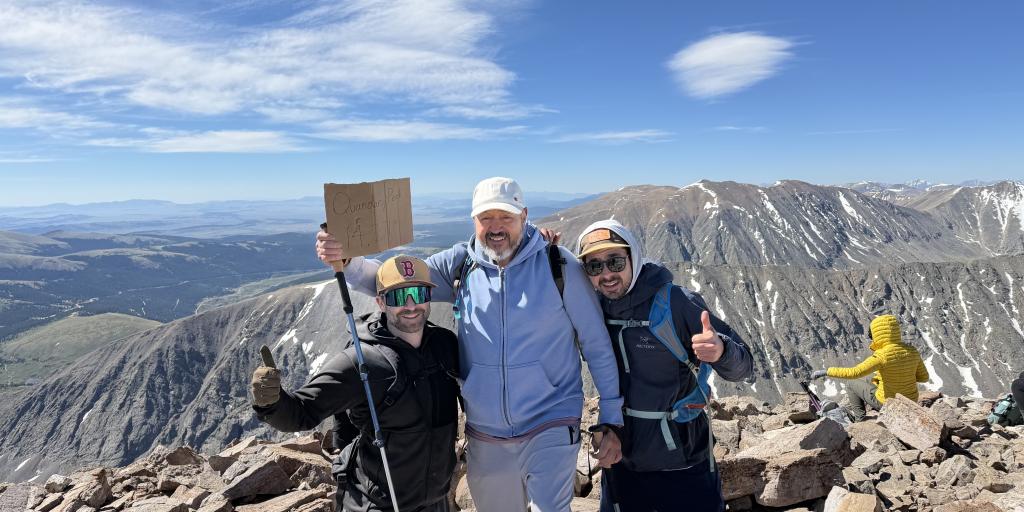
On June 16, that dream became reality. Alongside Kiernan and Ely, Maverick successfully summited Quandary Peak, one of Colorado’s iconic 14ers, reaching an elevation of 14,271 feet.
The achievement represented far more than a mountain summit. It was the culmination of a year of determination, resilience, and trust in the rehabilitation process. It showcased what can happen when Veterans are empowered with expert care, innovative rehabilitation technologies, and a team that believes in their potential.
“I was amazed at how much they’re doing for me, to keep me going, to encourage me to stay active,” said Lewis. “I’m just blown away. I have nothing negative to say about the VA. They’ve been nothing but helpful, generous to me in my recovery.”
For Maverick, Quandary Peak was proof that the limitations he once faced did not define what he could accomplish. For the SCI/D team, it was a powerful reminder of why they do what they do: helping Veterans achieve goals that once seemed out of reach.
“He’s really taken advantage of the resources SCI has,” said Ely. “It’s all him. He had the motivation. He’s always at our programs. He’s just trying to get better. I just wanted to be a part of that, because he’s worked hard at that.”
And Lewis hopes other veterans who read his story, know they can still achieve their goals, too, even after serious injuries.
“There’s hope, no matter what,” said Lewis. “If anyone reads my story, and they’re encouraged by it, then, that climb was more than worth it. It’s like I carried them along with me.”
And he, along with the SCI/D, has already laid the groundwork to help encourage others.
“Due to this experience, my therapist said they’re going to try and make this an annual event and include other veterans to show them. We’re starting an early morning workout program for all veterans in the spine center. My therapist said it was due in part to my efforts.”
One year ago, Lewis wanted to walk a little better.
Today, he can say he climbed a mountain.
“The VA can provide tools to get you to where you want to go if you’re consistent and you have the motivation to do,” said Ely. “You can do it, and there are people here to help you reach those goals. You just have to be involved and be committed to those goals. And if you show commitment, the therapist will be there for you, 100%. I hope veterans learn that therapists are here to help them. If they have a goal that they may think is farfetched, we may be able to get them.”
For veterans suffering from spinal cord injuries, or those who are caring for veterans suffering from spinal cord injuries, they can speak with their primary doctor about the SCI service, and if they have a spinal cord injury or are appropriate for the center, their primary care doctor can put in a consult for them to come to the SCI Center.
The center covers a wide area, seeing veterans from as far south as New Mexico and up into South Dakota. If veterans have questions about the SCI service, they can visit VA ECHCS’ webpage for more information.