


Motivated by Music
By Lacey Wedell, Inpatient Clinical Dietitian
Donald Joslin began playing musical instruments at the age of 10 and taught himself guitar at the age of 12.
He said he grew up in a dysfunctional household and found music as a source of joy and escape.
In 1972, when Joslin was only 17, he joined the U.S. Navy. “I joined to get the heck out of my mom’s house, and they promised to send me to San Francisco,” said Joslin.
During his service an electronic warfare technician, the music in his life quieted. So, after his service was up, it was time for the melody of life to return, and he joined a five-piece band called Hot Lips.
“I wanted to follow my heart and do what made me happy, not what made me the most amount of money,” said Joslin. Hot Lips toured nationally for nearly seven years.
After touring, he wanted to take his years of musical experience and apply it to formal musical education. Thanks to the GI Bill, Joslin was able to attend the University of Wisconsin, La Crosse to study music theory and composition. While his employment after college wasn’t in the music business, music always stayed his passion. After retiring, he built a studio in his home to create and record music.
In August of 2025, Joslin had a fall resulting in a tetraplegic spinal cord injury. Tetraplegia leads to reduced or lost movement and sensation in all four limbs and the torso. He was admitted into Minneapolis VA Spinal Cord Injury and Disorder Center for rehabilitation one month later.
When Minneapolis VA staff asked about his rehabilitation goals, Joslin shared that one of his primary goals was to “play guitar again.” He told his care team about his lifelong passion for music, and his team worked to identify ways to help meet his musical goals through an interdisciplinary approach.
“They did so much to find out what would work to make the music sing once more,” he said about the Spinal Cord Injury team which included experts in occupational therapy, music therapy, speech pathology, prosthetics, and recreational therapy. The whole team was present as he learned a new way to play music on his journey to recovery, in a new instrument, the harmonica.
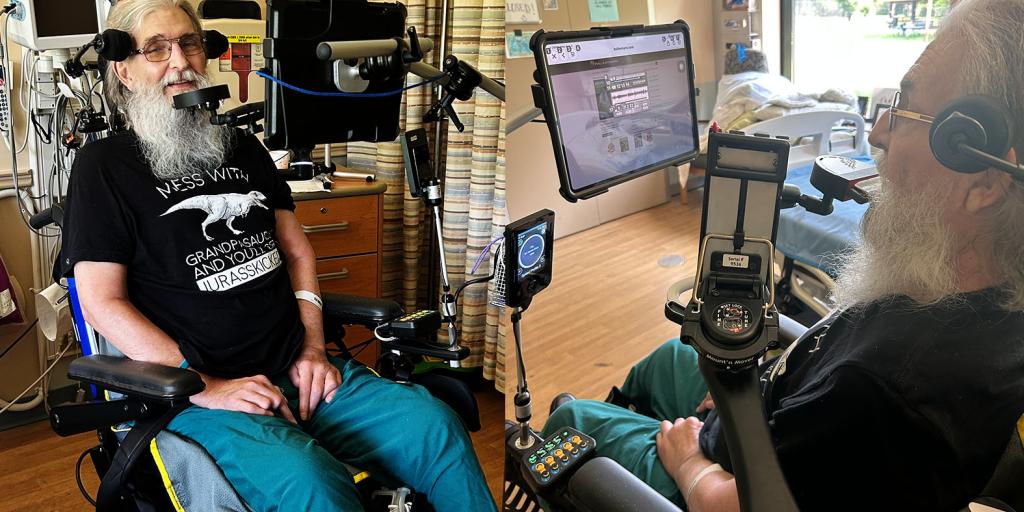
Due to his type of injury, Joslin has minimal upper body movement. With a little creativity and a lot of trial and error, the team helped him determine a mouthpiece instrument that would allow the greatest level of independence. While he has experience with many instruments, the harmonica was not one of those. Not only did Joslin learn how to play the harmonica he learned how to independently play without any hands holding the instrument. Using voice commands, he can start and stop music tracks on his tablet and record audio. With much determined practice, he has taken his many years of musical experience into becoming a budding harmonica player. “It gave me music back,” he said.
He hopes to draw upon his years as a traveling musician and his newly acquired harmonica skills to continue performing after his discharge from rehabilitation. Joslin has one piece of advice to new spinal cord injury patients interested in pursuing music after their injury: “enjoy the instrument [whatever it may be] and what it will do for you.”