


Disasters and evacuations don’t wait for anything, even in the middle of surgery
By Gregory House, Public affairs specialist
What happens when a disaster strikes in the middle of an operation?
The team in an operating room (OR) is robust by design. Nurses, aestheticians, and surgeons all have important rolls when it comes to protecting and healing their patients.
Recently, members of the OR team at VA Salt Lake City Health Care System (VASLCHCS) completed an OR evacuation drill to train them for just that scenario.
The operating room at the George E. Wahlen VA Medical Center is on the third floor of the main hospital, so if the team had to evacuate, their first priority is the safety of the patient.
The patient was not real, but the scenario was designed to feel real.
Tyler Knapp, a registered nurse at VASLCHCS volunteered to serve as the simulated patient, positioned on an operating table while the team responded to an emergency requiring him to be stabilized and moved from the operating room.
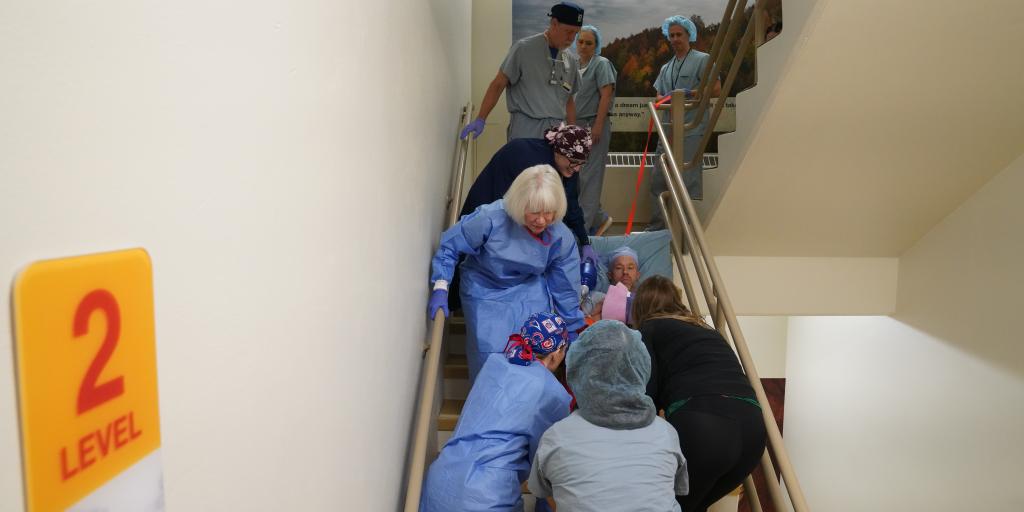
The exercise required the team to communicate clearly, coordinate their movements and trust one another. The team- worked to move the patient onto a specialized evacuation stretcher, quickly and carefully sliding the patient down the stairs and out of a side door where an emergency transportation bus was waiting.
From Knapp’s perspective, the exercise offered a new view of the team’s response.
“It was a simulated evacuation of a patient who was mid-procedure,” Knapp said. “I felt safe the whole time. It was interesting to see everybody interacting and communicating… It was nice to see that everyone’s main goal was the safety of the patient.”
Greg Livers, a general surgeon at VASLCHCS appreciated the safety drill for its effectiveness.
“You never know when something bad is going to happen and doing an online module or something like that isn’t nearly as effective as having hands-on experience,” Livers said. “It helps with your confidence in keeping patients safe.”
As the exercise unfolded, team members communicated the patient’s condition, coordinated the transfer and safely navigated the evacuation route. Each person had a role, but the success of the response depended on how well those individual roles came together.
That was perhaps the most important lesson of the exercise.
Emergency preparedness is not simply about having the right equipment or knowing the right procedure. It is about creating a team that can function under pressure.
James Lu, an industrial hygienist with the occupational safety team at VASLCHCS said one of the most important parts of these safety drills is learning the muscle memory to act in an emergency without over-thinking.
“The most critical thing is that during an emergency, there is a lot of chaos and people can be in a much more heighted state of stress,” Lu said. “That’s when hands-on training can kick in and help make sure people respond correctly and makes our patients more safe.”
The scenario may have been simulated, but the lesson was real: when an emergency happens, there is no time to figure out teamwork for the first time.
The team must be ready to move together.