


Think Healthy Thursday: Know Your Numbers — Understanding Cholesterol
By Gloria Hairston, Director of Public Affairs
Your VA Health Promotion and Disease Prevention team is helping Veterans to take control and live with healthy cholesterol
September is National Cholesterol Education Month, and your DC VAMC's Health Promotion and Disease Prevention Coordinator, Terri Howard, and the team are here to break down what cholesterol actually is — and what you can do to keep yours in check.
What is Cholesterol?
According to Nurse Terri Howard, “Cholesterol gets a bad reputation, but it does not have to be all bad.”
Cholesterol is a waxy, fat-like substance your body actually needs — to build cells, make hormones, and digest fats. Your liver makes most of what you need; the rest comes from animal-based foods like meat, eggs, and dairy. The trouble starts when saturated fat and trans-fat push your levels too high, raising your risk for heart disease.
Nurse Terri Howard also warns us and suggests we, “Read the food labels and ingredients. Avoid foods that are hydrogenated, which refers to artificial trans fats that are unsafe and cause risk for heart disease.”
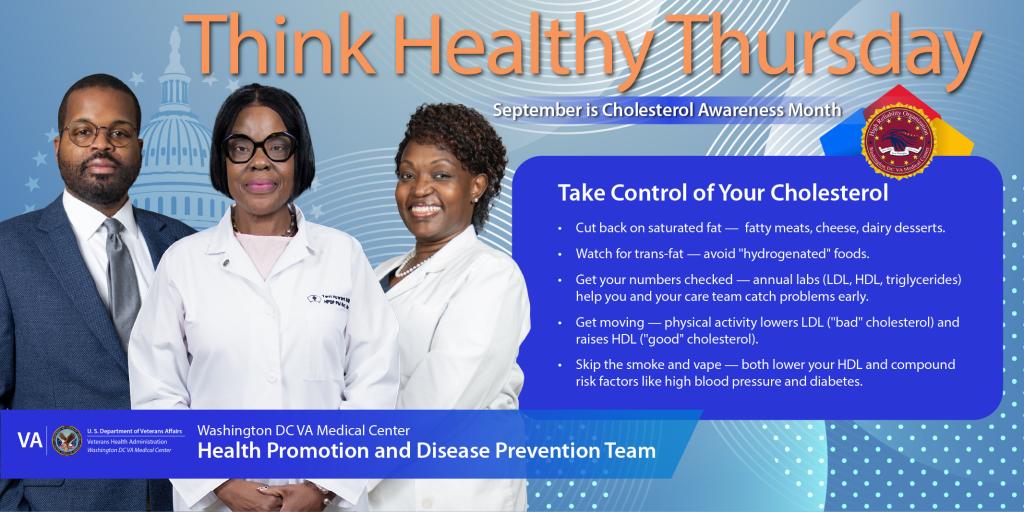
6 Ways to Take Control of Your Cholesterol
- Cut back on saturated fat — think fatty meats, cheese, dairy desserts, and tropical oils like palm oil.
- Watch for trans-fat — if "hydrogenated" is on the ingredient list, that's your cue to put it back on the shelf.
- Eat what you enjoy, the healthy way — colorful fruits and veggies, nuts, beans, legumes, whole grains, and lean protein. Healthy doesn't have to mean flavorless.
- Get your numbers checked — annual labs (LDL, HDL, triglycerides) help you and your care team catch problems early. Ask your Healthcare Team for their recommendation.
- Get moving — physical activity lowers LDL ("bad" cholesterol) and raises HDL ("good" cholesterol). Walking, dancing, swimming, even gardening all count.
- Skip the smoke and vape — both lower your HDL and compound risk factors like high blood pressure and diabetes.
Talk to Your VA Care Team
Your VA health care team is your partner in prevention. Do not wait for a diagnosis — ask questions, get your labs done, and build a plan that works for your life.
Small, consistent changes add up to a healthier heart. Here's to your health, Veterans, think healthy, live well!